Does ISO 9001 require a carbon inventory for climate change?
ISO 9001 氣候變遷條文,工廠要不要做碳盤查?
ISO 9001 asks the organization to determine whether climate change is a relevant issue. It does not require a greenhouse gas inventory. This article explains how to pass the audit with either answer.
ISO 9001 要求組織判定氣候變遷是不是相關議題,並沒有要求做溫室氣體盤查。本文說明兩種判定結果各自要怎麼通過稽核。
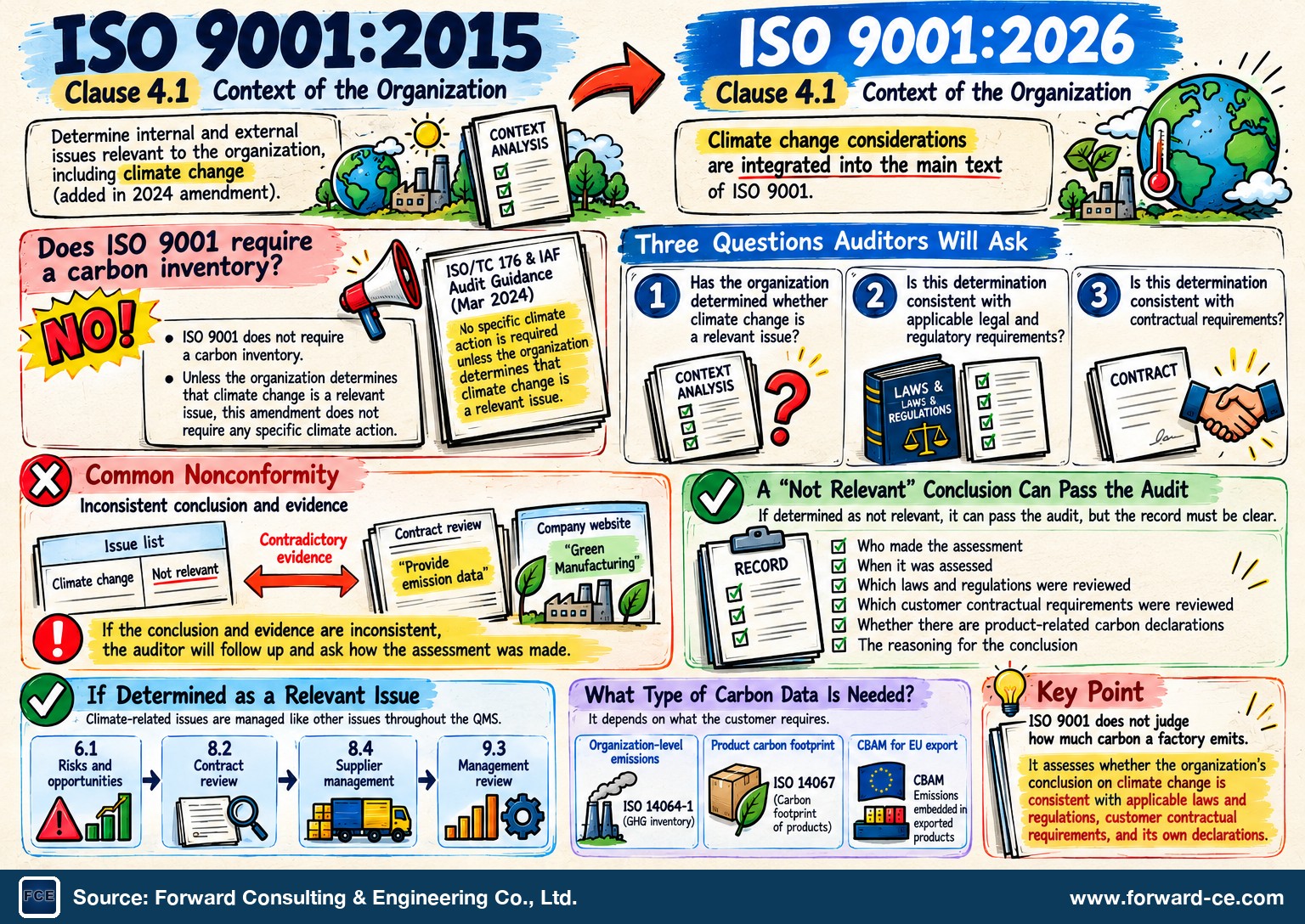
Since Amendment 1:2024, ISO 9001 clause 4.1 has required the organization to determine whether climate change is a relevant issue. ISO 9001:2026 carries this requirement into the main text. Factories have asked us whether this requirement obliges them to prepare a carbon inventory.
ISO 9001 does not require a carbon inventory. The guidance referred to in this article is Auditing Climate Change issues in ISO 9001, published in March 2024 by the ISO 9001 Auditing Practices Group, a joint group of ISO/TC 176 and the International Accreditation Forum. It states that the amendment "does not require an organization to have climate change initiatives unless it has been identified as a relevant issue to achieve the intended results of the QMS."
Why a factory may still need carbon data
The guidance describes the auditor's role as assessing whether the organization determined if climate change is relevant to its quality management system and, if it is, how the system addresses it. The guidance also notes that auditing the methods behind climate-related product claims may be outside the objectives of an ISO 9001 audit. The correctness of a carbon inventory calculation is therefore generally outside the scope of an ISO 9001 audit.
A factory can still be required to produce carbon data for reasons outside ISO 9001:
- Regulation. In Taiwan, the Ministry of Environment requires power, steel, petroleum refining, cement, semiconductor and display panel plants, and any facility whose direct and electricity-related emissions reach 25,000 tonnes CO₂e a year, to register an annual inventory by 30 April. In March 2025 the ministry extended the requirement to selected sectors with estimated emissions between 10,000 and 25,000 tonnes.
- Customers. Customers ask for company emissions, product carbon footprints, or embedded emissions for products that fall under the EU CBAM.
- The factory's own claims. If a catalogue or website describes a product as low carbon, clause 8.2.2 b) requires the factory to show that it can meet the claim. The guidance asks auditors to pay particular attention to such claims.
Passing the audit with a not relevant determination
The guidance lists three questions for the auditor:
- Has the organization determined whether climate change is a relevant issue?
- Does the organization's determination align with the statutory and regulatory requirements applicable to its products and services?
- Does the organization's determination align with its contractual requirements?
A determination that climate change is not relevant is acceptable. The guidance itself notes that auditors will find organizations that have considered climate change and found it not relevant to their QMS. The record has to answer the three questions above, and we suggest that it covers the following points:
| Item | Example |
|---|---|
| Who assessed it and when | Quality manager and sales manager, management review in March 2026 |
| Regulations checked | Whether the plant is covered by the national inventory registration rules, and whether its products fall under CBAM |
| Contracts and customer requirements checked | Carbon clauses in RFQs, purchase orders and supplier codes of conduct from the past year |
| Climate-related claims | Catalogue, website and product labels |
| Physical risks to operations | Storms, floods or drought that could interrupt supply or delivery, which the guidance lists as an example |
| Conclusion and reason | No regulatory or contractual requirement applies, the products carry no climate claims, and the assessed physical risks do not affect product conformity, so the issue is not relevant |
| When it will be reassessed | At every management review, or when a customer raises a carbon requirement |
A finding can arise when the context record states "not relevant" but the auditor finds a customer request for emissions data in the contract review file, or a "green manufacturing" claim on the company website. The determination then contradicts the evidence, and the auditor will go back to 4.1 and ask how the assessment was made.
Proceeding when climate change is relevant
Step 1. Handle the issue inside the quality system
The guidance says that a relevant climate issue follows the same path as any other issue. The clauses involved are:
- 4.3 Scope. The factory decides whether the issue changes the QMS scope. The guidance gives the example of an organization that considered moving because of a higher flood risk at its current site.
- 6.1 Risks and opportunities. A risk can be a customer requirement for carbon data that the factory cannot yet meet. An opportunity can be a tender in which suppliers with carbon data are preferred.
- 8.2 Requirements for products. Contract review includes the customer's carbon requirements, and the factory accepts the order only when it can meet them.
- 8.4 External providers. The factory passes data requirements to its suppliers, for example a request for a carbon footprint of the steel it buys.
- 9.1 and 9.3. The data should come from reliable sources, and the management review should evaluate whether the actions were effective.
Step 2. Produce the carbon data the customer actually needs
| Customer request | Standard | Typical scope |
|---|---|---|
| Company emissions | ISO 14064-1 organizational inventory | Start with direct emissions from fuel and refrigerant and indirect emissions from purchased electricity |
| Emissions per unit of product | ISO 14067 product carbon footprint | Calculated over the product life cycle stages defined in the study |
| Steel, aluminium and other goods exported to the EU | CBAM embedded emissions | Calculated under the EU CBAM rules |
An organizational inventory follows these steps: set the organizational boundary, list the emission sources, collect one year of activity data such as fuel, gas, electricity and refrigerant top-ups, apply the official emission factors, select a base year and write the inventory report. Third-party verification is added when a regulation or a customer requires it. A small or medium factory without a regulatory obligation can start with direct emissions and purchased electricity.
Using one data set for both purposes
The information collected for carbon data, such as material sources, process energy and production volumes, is also the evidence a credible 4.1 and 6.1 assessment needs. When one team uses one data set for both purposes, the factory avoids contradictions between the climate assessment and the carbon figures at the audit.
An ISO 9001 audit assesses whether the factory's conclusion on climate change is consistent with the applicable regulations, its contracts and its own claims, and it does not assess the quantity of emissions.
This article is based on the ISO 9001 Auditing Practices Group paper Auditing Climate Change issues in ISO 9001, Edition 1, 19 March 2024. The paper states that it has not been subject to a formal endorsement process by ISO or IAF. Taiwan inventory registration rules are summarised from the Ministry of Environment announcements as reported in 2025; check the current rules before relying on them.
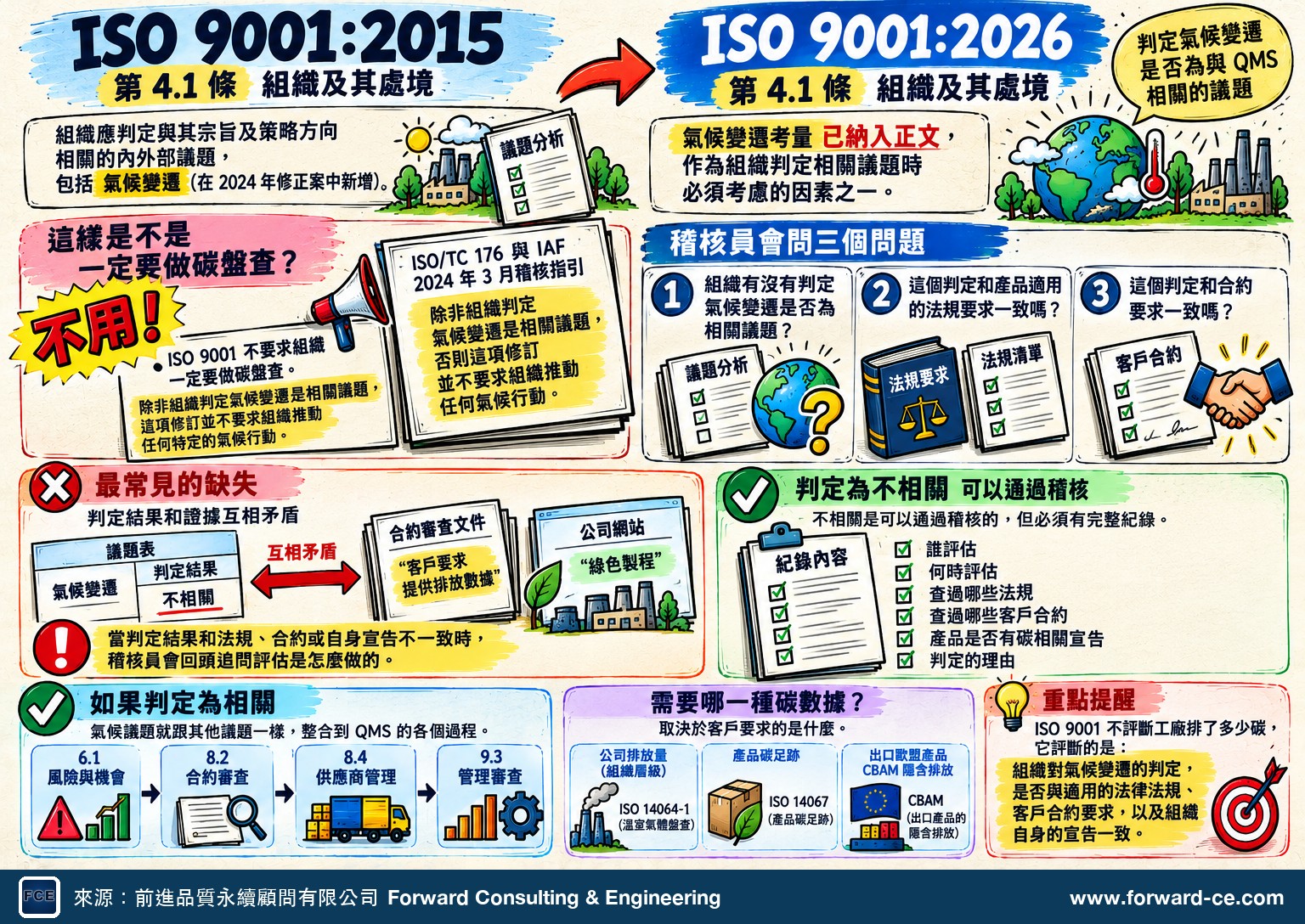
ISO 9001 從 2024 年的修訂單 Amd 1 開始,在 4.1 要求組織判定氣候變遷是否為相關議題,ISO 9001:2026 也把這項要求寫進了本文。多家工廠曾詢問本公司,這項要求是否代表必須執行碳盤查。
ISO 9001 並未要求組織執行碳盤查。本文引用的依據是 ISO 9001 稽核實務小組(Auditing Practices Group)在 2024 年 3 月發布的《Auditing Climate Change issues in ISO 9001》,這個小組由 ISO/TC 176 與國際認證論壇(IAF)共同組成。文件明白寫著,除非組織判定氣候變遷是達成品質系統預期結果的相關議題,否則這次修訂並不要求組織推動任何氣候行動。
工廠仍可能需要碳數據的情況
這份指引把稽核員的角色定義為:評估組織是否已判定氣候變遷與品質系統是否相關;如果相關,再評估品質系統如何處理。指引也提到,產品碳宣告背後的計算方法,可能超出 ISO 9001 稽核的目的。因此,碳盤查計算是否正確,一般不在 ISO 9001 稽核的查核範圍內。
然而,工廠仍可能因為 ISO 9001 以外的理由,必須提出碳數據:
- 法規。台灣環境部規定,發電、鋼鐵、石油煉製、水泥、半導體、面板業,以及全廠直接排放加用電間接排放每年達 2.5 萬公噸 CO₂e 的事業,每年 4 月 30 日前要完成盤查登錄。環境部在 2025 年 3 月把預估排放量介於 1 萬到 2.5 萬公噸的部分行業也納入列管。
- 客戶。客戶要求提供公司排放量、產品碳足跡,或是歐盟 CBAM 範圍內產品的隱含排放量。
- 工廠自己的宣告。若型錄或網站將產品描述為「低碳產品」,依 8.2.2 b),工廠必須證明能符合該宣告,指引也特別提醒稽核員注意這類宣告。
判定不相關時如何通過稽核
指引列出稽核員要問的三個問題:
- 組織是否已判定氣候變遷是否為相關議題?
- 這個判定是否與產品與服務適用的法規要求一致?
- 這個判定是否與組織的合約要求一致?
判定為不相關是可以接受的,指引本身就提到稽核員會遇到評估後判定不相關的組織。紀錄必須能回答上面三個問題,我們建議涵蓋以下內容:
| 項目 | 範例 |
|---|---|
| 誰評估、何時評估 | 品保主管與業務主管,2026 年 3 月管理審查 |
| 查了哪些法規 | 工廠是否屬於環境部盤查登錄對象、產品是否屬於 CBAM 範圍 |
| 查了哪些合約與客戶要求 | 近一年的詢價單、採購合約、供應商行為準則中有沒有碳相關條款 |
| 有沒有氣候相關宣告 | 型錄、網站與產品標籤 |
| 營運面的實體風險 | 颱風、水災、乾旱造成供應中斷或交貨困難,這是指引列出的例子 |
| 結論與理由 | 目前沒有法規或合約要求,產品沒有碳宣告,評估過的實體風險也不影響產品符合性,因此判定不相關 |
| 下次重新評估的時機 | 每次管理審查,或接到客戶的碳要求時 |
若內外部議題表記載「不相關」,稽核員卻在合約審查文件中看到客戶要求提供排放數據,或在公司網站上看到「綠色製程」的宣傳,判定結果即與證據互相矛盾。此時稽核員會回頭查核 4.1 的評估方式,並可能開立缺失。
判定相關時的處理方式
第一步:在品質系統裡處理
指引說明,相關的氣候議題應依照其他議題相同的方式處理。牽涉的條文如下:
- 4.3 範圍。工廠判斷這個議題會不會改變品質系統的範圍。指引舉的例子是組織因為現址淹水風險升高而考慮遷廠。
- 6.1 風險與機會。風險可以是客戶要求碳數據,而工廠目前無法提供;機會可以是招標時優先考慮能提供碳數據的供應商。
- 8.2 產品要求。合約審查應納入客戶的碳要求,工廠確認能夠符合後才接受訂單。
- 8.4 外部供應者。工廠把數據要求傳遞給供應商,例如要求鋼材供應商提供碳足跡。
- 9.1 與 9.3。數據應有可靠的來源,管理審查應檢討措施的有效性。
第二步:產出客戶真正需要的碳數據
| 客戶要求 | 對應標準 | 一般範圍 |
|---|---|---|
| 公司整體排放量 | ISO 14064-1 組織型盤查 | 先從燃料、冷媒的直接排放與外購電力的間接排放做起 |
| 每單位產品的排放量 | ISO 14067 產品碳足跡 | 依研究界定的生命週期階段計算 |
| 出口歐盟的鋼鋁等產品 | CBAM 隱含排放 | 依歐盟 CBAM 規則計算 |
組織型盤查的步驟是:設定組織邊界、盤點排放源、蒐集一年的活動數據(油、氣、電與冷媒填充量)、套用官方公告的排放係數計算、選定基準年,最後撰寫盤查報告。法規或客戶要求時,再委託第三方查證。沒有法規義務的中小型工廠,可以先從直接排放與外購電力兩部分開始。
氣候評估與碳數據使用同一套資料
蒐集碳數據時使用的資料,例如原料來源、製程能耗與產量,也是 4.1 與 6.1 氣候評估需要的依據。由同一組人員使用同一套資料處理兩項工作,可避免稽核時氣候評估與碳數據互相矛盾。
ISO 9001 稽核評估工廠對氣候變遷的結論是否與適用法規、合約以及工廠本身的宣告一致,並不評估排放量的多寡。
本文依據 ISO 9001 Auditing Practices Group,Auditing Climate Change issues in ISO 9001,第 1 版,2024 年 3 月 19 日。該文件註明未經 ISO 或 IAF 正式背書程序。台灣盤查登錄規定依 2025 年環境部公告的相關報導整理,引用前請確認最新法規。