ISO 9001:2026 changes compared with ISO 9001:2015, and what factories need to update
ISO 9001:2026 與 2015 版差異比較,工廠要改哪些地方
The 2026 edition keeps the structure of the 2015 edition. For a factory, the required changes are concentrated in a few registers, forms, training records and procedure references.
2026 版沿用 2015 版的架構。工廠需要修改的地方集中在幾張登錄表、表單、訓練紀錄和程序書的條號引用。
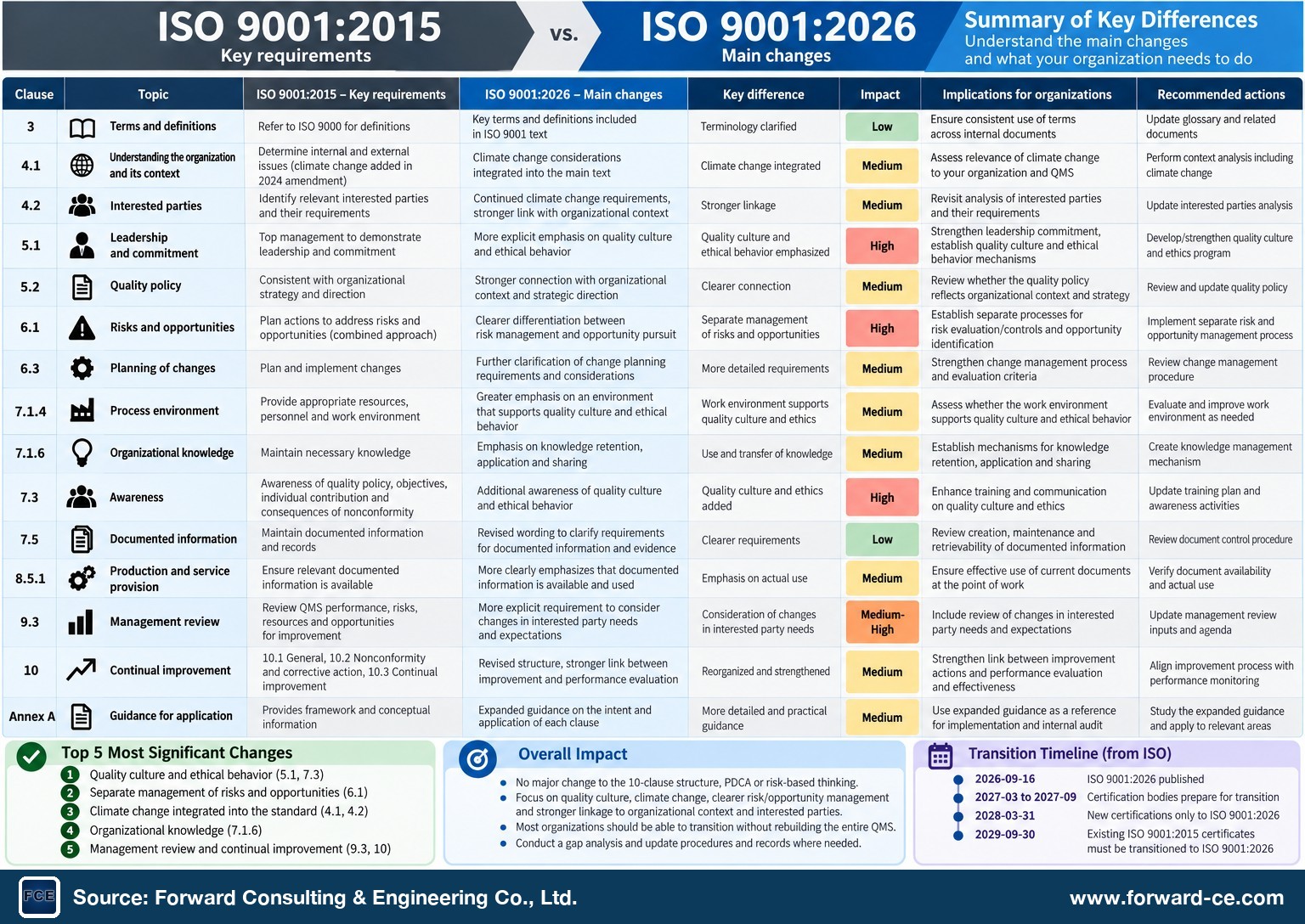
ISO published ISO 9001:2026 on 16 September 2026. Certification bodies describe the extent of change as moderate and smaller than the 2015 revision. Clauses 4 to 10 keep the same layout, and the process approach and risk-based thinking remain the basis of the standard. A factory does not need to rewrite its quality manual.
Each change, however, adds evidence that an auditor can request. Our earlier article explains why the climate requirement can no longer be answered with one line. This article compares the two editions clause by clause and lists what a factory needs to update.
Clause-by-clause comparison
| Clause | ISO 9001:2015 | ISO 9001:2026 | What the factory updates |
|---|---|---|---|
| 3 | Refers to the terms in ISO 9000 | Lists the harmonized structure terms in the standard and still refers to ISO 9000 | Align the internal glossary with the new terms |
| 4.1, 4.2 | Climate change was added by Amendment 1:2024 | Climate change is part of the main text | Keep a dated record of how climate change was assessed and which customer requirements apply |
| 5.1 | Leadership commitments do not mention culture or ethics | Top management promotes quality culture and ethical behaviour | Keep records of the actions taken by top management in addition to the policy statement |
| 6.1 | Risks and opportunities are handled together | Separate sub-clauses for risks (6.1.2) and opportunities (6.1.3) | Plan actions for risks and for opportunities separately, for example in two registers |
| 6.3 | Planning a change considers its purpose, QMS integrity, resources and responsibilities | Planning also covers how the change is communicated, how its effectiveness is monitored and how the results are reviewed | Add these three fields to the change request form |
| 7.1.6 | Knowledge is determined, maintained and made available | Knowledge is also retained, applied and shared | Document the knowledge held by key personnel so that other employees can use it |
| 7.3 | Awareness covers the policy, objectives, contribution and the effect of nonconformity | Awareness also covers quality culture and ethical behaviour | Add the topic to induction and refresher training |
| 10 | Three sub-clauses: 10.1, 10.2 and 10.3 | Two sub-clauses; continual improvement is merged into 10.1 | Update procedures and audit checklists that refer to 10.3 |
| Annex A | Short guidance | Expanded guidance on the intent of each clause, with no new requirements | Use it to interpret the new wording during the gap analysis |
Clause 8 (operation) and clause 9 (performance evaluation) carry over with limited change. Some clause-by-clause reviews also mention edits to 8.1, the internal audit programme in 9.2.2 and the management review inputs in 9.3. These should be checked against the purchased standard during the gap analysis.
Changes required in the factory
1. The context and interested party record (4.1, 4.2)
The quality manager should rewrite the record with real inputs: carbon data requests in customer RFQs, supplier codes of conduct, products exported to the EU that fall under CBAM, and requests for ISO 14067 product carbon footprints. The record should show who made the assessment and when. A climate entry that is relevant should lead to at least one item in the risk or opportunity register. Whether this requires a carbon inventory is explained in a separate article.
2. Separate registers for risks and opportunities (6.1)
Some factories record opportunities only as an additional column in the risk register. The 2026 edition requires the organization to determine opportunities and plan actions for them separately from risks. A separate opportunity register, with its own actions, owners and dates, is one practical way to show that this has been done. Examples from a fabrication shop include qualifying a second welding procedure to win a new customer or offering product carbon data before the customer asks for it.
3. Additional fields on the change request form (6.3)
Typical changes in a factory are a new consumable supplier, a new CNC machine, or moving a process to a subcontractor. For each change, the form should state who will be informed, how the factory will monitor the effectiveness of the change, and how and when the results will be reviewed. A change that is closed without a recorded review of its results does not meet this requirement.
4. Retention of organizational knowledge (7.1.6)
In some factories the knowledge behind welding procedures, heat treatment set-ups or customer inspection requirements is held by one senior engineer or inspector. The factory should document this knowledge, store it where other employees can access it, and use it in training before that person retires or changes jobs.
5. Leadership evidence and awareness training (5.1, 7.3)
Quality culture is demonstrated through the behaviour of personnel. In our work as client representative inspectors, we observe whether production stops at a hold point when the inspector has not yet arrived, and whether a nonconformity is closed only after its root cause has been identified. The factory should record management decisions of this kind and add quality culture and ethical behaviour to induction training.
6. Clause references in procedures and audit documents (clause 10 and others)
Procedures, internal audit checklists and the management review agenda often cite clause numbers. The factory should update every reference to the old 10.3 and to the old 6.1 numbering, so that audit findings can be traced to the right clause.
Transition timeline
| Date | Milestone |
|---|---|
| 16 September 2026 | ISO 9001:2026 published |
| Around March 2028 | New initial certifications expected to be issued to the 2026 edition only |
| 30 September 2029 | ISO 9001:2015 certificates cease to be valid |
Certification bodies may set earlier cut-off dates of their own, so the factory should ask its certification body for the applicable dates in writing. A practical order of work is a gap analysis against the 2026 text, the register and form changes described above, updated training, and then an internal audit and management review on the new basis before the transition audit.
The transition audit assesses implementation as well as documentation. The new registers and form fields should therefore be in use before the audit takes place.
This article is based on published transition guidance from certification bodies (DNV, SGS, LRQA), the ISO announcement of 16 September 2026, and independent clause-by-clause reviews. Clause wording should be confirmed against the purchased ISO 9001:2026 text.
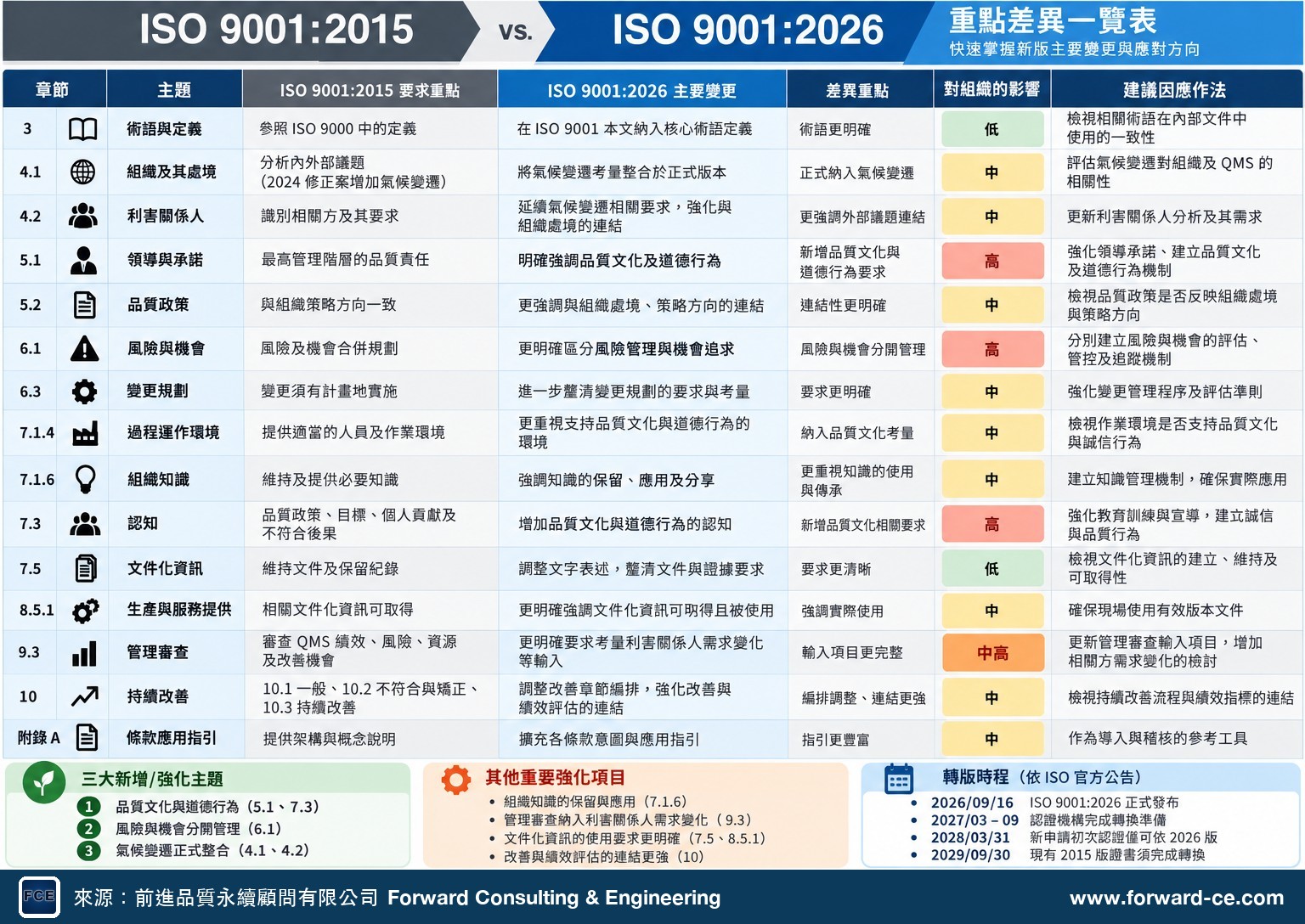
ISO 於 2026 年 9 月 16 日發布 ISO 9001:2026。驗證機構評估這次的改版幅度屬於中等,幅度小於 2015 年的改版。第 4 到第 10 章的架構不變,流程導向與風險基礎思維仍是標準的基礎,工廠不需要重寫品質手冊。
然而,每一項變更都會增加稽核員可以要求查核的證據。本公司先前的文章說明了氣候變遷為什麼不能再一行帶過,本文則逐條比較兩個版本,並列出工廠需要更新的項目。
逐條對照
| 條文 | ISO 9001:2015 | ISO 9001:2026 | 工廠要更新的地方 |
|---|---|---|---|
| 3 | 引用 ISO 9000 的術語 | 在標準內列出共通架構的術語,仍引用 ISO 9000 | 內部名詞定義與新術語對齊 |
| 4.1、4.2 | 氣候變遷由 2024 年修訂單 Amd 1 加入 | 氣候變遷成為標準本文 | 保存有日期的紀錄,說明氣候變遷怎麼評估、有哪些客戶要求 |
| 5.1 | 領導承諾沒有提到文化與道德 | 最高管理階層要促進品質文化與道德行為 | 除政策聲明外,另保存最高管理階層實際作為的紀錄 |
| 6.1 | 風險與機會合在一起處理 | 風險(6.1.2)與機會(6.1.3)各有子條款 | 分別規劃風險與機會的措施,例如分成兩份登錄表 |
| 6.3 | 規劃變更時考量目的、系統完整性、資源與職責 | 還要規劃變更怎麼溝通、怎麼監督有效性、怎麼審查結果 | 變更申請單增加這三個欄位 |
| 7.1.6 | 知識要確定、維持並使人員可取得 | 知識還要保存、應用與分享 | 將關鍵人員掌握的知識整理成文件,供其他人員使用 |
| 7.3 | 認知涵蓋政策、目標、個人貢獻與不符合的後果 | 認知加入品質文化與道德行為 | 新進人員訓練與定期訓練加入這個主題 |
| 10 | 三個子條款:10.1、10.2、10.3 | 整併為兩個子條款,持續改善併入 10.1 | 更新程序書與稽核查檢表中引用 10.3 的地方 |
| 附錄 A | 簡短指引 | 擴充為說明各條文意圖的指引,沒有新增要求 | 做落差分析時用來解讀新條文 |
第 8 章(運作)與第 9 章(績效評估)大致延續 2015 版。部分逐條分析文章提到 8.1、9.2.2 內部稽核方案與 9.3 管理審查輸入也有文字調整,做落差分析時應對照購得的標準原文確認。
工廠需要調整的項目
一、內外部議題與利害關係者紀錄(4.1、4.2)
品質主管應依據實際資訊重新撰寫這份紀錄,例如客戶詢價單裡的碳數據要求、供應商行為準則、出口歐盟且屬於 CBAM 範圍的產品,以及客戶要求的 ISO 14067 產品碳足跡。紀錄要寫明由誰評估、何時評估。如果判定氣候變遷是相關議題,風險或機會登錄表裡至少要有一項對應的措施。要不要因此做碳盤查,請見這篇說明。
二、風險與機會分別建立登錄表(6.1)
部分工廠僅將機會記錄為風險登錄表中的一個欄位。2026 版要求組織將機會與風險分開鑑別,並分別規劃措施。另行建立一份機會登錄表,列出措施、負責人與期限,是證明已落實這項要求的一種可行做法。以製造廠為例,機會可以是再評定一份焊接程序以爭取新客戶,或是在客戶提出要求之前主動提供產品碳數據。
三、變更申請單增加欄位(6.3)
工廠常見的變更包括更換焊材供應商、新增一台 CNC 機台,或是把某道製程外包。每一項變更都應寫明需要通知的人員、工廠監督變更有效性的方式,以及結果審查的方式與時機。變更結案時若沒有結果審查的紀錄,即不符合此項要求。
四、組織知識的保存(7.1.6)
部分工廠的焊接程序、熱處理參數或客戶檢驗要求,僅由一位資深工程師或檢驗員掌握。工廠應在該人員退休或調職之前,將關鍵知識整理成文件,存放於其他人員可取得之處,並納入教育訓練。
五、管理階層的證據與認知訓練(5.1、7.3)
品質文化透過人員的實際行為展現。本公司執行業主代表檢驗時,會觀察檢驗員尚未到場時生產線是否在停留點停止作業,以及不符合事項是否在找出根本原因後才結案。工廠應記錄這類管理決定,並在新進人員訓練中納入品質文化與道德行為。
六、程序書與稽核文件引用的條號(第 10 章與其他)
程序書、內部稽核查檢表與管理審查議程經常引用條號。工廠應更新所有引用舊版 10.3 與舊版 6.1 編號之處,使稽核發現能對應到正確的條文。
轉版時程
| 日期 | 里程碑 |
|---|---|
| 2026 年 9 月 16 日 | ISO 9001:2026 發布 |
| 約 2028 年 3 月 | 預計新申請的初次驗證只能採用 2026 版 |
| 2029 年 9 月 30 日 | ISO 9001:2015 證書失效 |
驗證機構可能自行訂定更早的截止日,工廠應該請自己的驗證機構以書面提供適用的日期。實務上的順序是先對照 2026 版條文做落差分析,接著完成上述登錄表與表單的修改、更新教育訓練,然後在轉版稽核前依新版要求完成一輪內部稽核與管理審查。
轉版稽核除了查核文件,也會評估實施情形。因此,新的登錄表與表單欄位應在稽核前實際使用。
本文依驗證機構(DNV、SGS、LRQA)公開的轉版指引、ISO 於 2026 年 9 月 16 日的發布公告,以及獨立的逐條分析文章整理。條文文字應以購得的 ISO 9001:2026 原文為準。